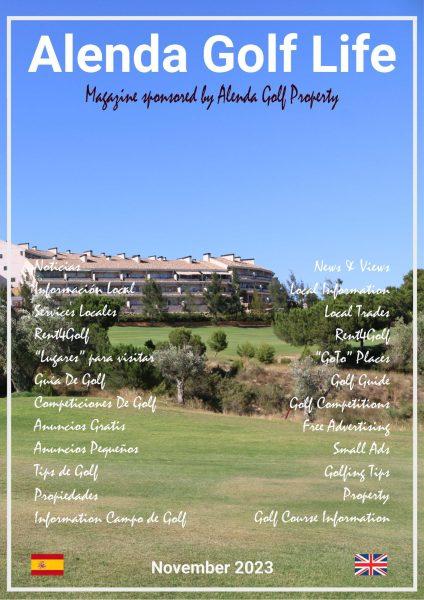
Welcome to Alenda Golf Life, the quintessential magazine dedicated to guiding residents, visitors, and property owners through the splendid experience of living, playing, or visiting Alenda Golf.
Click on the image to go straight to the magazine.
Starting May 2, EasyJet will commence flights from Belfast City to Alicante, Spain.
These flights are planned for Thursdays and Sundays, continuing throughout the summer season.
Discover the benefits of visiting Spain for golf enthusiasts. Alicante offers some of the most scenic and challenging golf courses in Europe. With a perfect blend of sunny weather, diverse landscapes, and impeccably maintained greens, it’s a paradise for golfers of all skill levels. Whether you’re looking to improve your game or simply enjoy a leisurely round in a beautiful setting, Alicante’s golf courses are a compelling reason to board an EasyJet flight this summer.
During your visit, explore the opportunity to own a piece of this golfer’s paradise by checking out frontline golf properties at Alenda Golf. These properties offer stunning views of the golf course, modern amenities, and a lifestyle imbued with the tranquillity and beauty of the surrounding landscape. Investing in a property at Alenda Golf not only promises a serene retreat but also places you right in the heart of one of Spain’s most sought-after golfing destinations, Alenda Golf.
Could the prospect of a tourist levy deter holidaymakers from choosing certain destinations? To dispel doubts, some Spanish areas have assured that British tourists will not be subject to the mooted tax.
Carlos Mazon, head of the Valencian Community, which includes Castellon, Valencia, and Alicante provinces, pledged just before the May election triumph that British visitors would not be hit with the feared tourist tax. This region, hosting the UK’s beloved Costa Blanca, has taken decisive action to ensure the proposed charge is not enforced.
Valencian Assurance
“The paperwork is almost complete,” Carlos Mazon, of Spain’s People’s Party, announced at the World Travel Market London, referring to measures to block the Valencian Community Tourist Tax.
Tourism Over Taxes
Mazon emphasised the value of British tourists, stating, “We want to reassure them that there’s no need to worry about this ideological tax distancing us from the British market, in particular.”
He shared his discomfort with the idea of such a tax: “On behalf of this community, I’m embarrassed to come to London and tell tourists that, despite being a source of wealth and income, they must pay for the privilege.”
A Welcoming Gesture
Mazon’s message was clear: “I want to come here and express our appreciation for their visits, which bring prosperity, and to extend a warm welcome.”
Regional Responses
While the Valencian Community has dismissed the tax, the Balearic Islands and Catalonia have implemented it. The Basque Country is still undecided. Asturias, under Adrian Barbon, has introduced the tax, allowing local councils to determine its application.
During his visit to the UK, Carlos Mazón, President of the Valencia Region, announced that EasyJet is set to establish a new base at the Alicante-Elche Miguel Hernández Airport. From this base, the airline will introduce nine new routes connecting with the UK, France, Switzerland, and the Czech Republic.
This development was confirmed following a meeting with representatives from the British airline, who reaffirmed their dedication to the Valencian Community. This will be EasyJet’s fourth base in Spain, operational from March 2024, and is expected to generate around 100 new jobs.
Mazón has confirmed that these new connections will facilitate the arrival of approximately 125,000 passengers to the region during the next summer season, promising a significant economic boost for the local tourism industry. This comes amidst concerns that the airport is currently under pressure to handle the surge in summer traffic, with ongoing debates about the need for a second runway and improved public transport links.
The new routes will specifically link Alicante to Southampton and Zurich starting from 31 March next year, and to Newcastle, Belfast, Prague, Lyon, Lille, Nantes, and Nice from April and May 2024.
The establishment of these new air routes is particularly advantageous for the Alicante area, offering owners and visitors, especially golf enthusiasts, improved connectivity and access to one of Spain’s premier golfing destinations.
The introduction of the ETIAS (European Travel Information and Authorisation System) now has a confirmed start date for when it will become a requirement for UK citizens wishing to enter any of the 30 EU member states. This system, informally likened to a visa, is part of the new travel requirements following the UK’s exit from the EU. It is set to be a prerequisite for those planning to visit popular destinations such as Spain, Greece, France, and Italy, with a fee attached.
For a number of years, the launch of ETIAS has been in the pipeline, but its deployment has faced multiple delays. The system, which will cost around £6, exempts travellers below the age of 18, those above 80, and EU nationals from its requirement.
The latest updates from the Schengen Council indicate a new timeline for rolling out the necessary IT systems. These systems, essential for combating crime, managing borders, and overseeing migration flows, need to be operational before the ETIAS can take effect.
An Entry/Exit System is also being introduced to replace manual passport stamping with an electronic registration process. This system, along with the ETIAS—an online travel authorisation for visa-exempt third-country nationals, including UK citizens—is in the stages of implementation.
The roadmap for this new IT architecture suggests that the Entry/Exit System should be operational by Autumn 2024 and the ETIAS by Spring 2025. This means that from Spring 2025, UK citizens planning to visit EU countries will need to apply for ETIAS, which will cost £6 and remain valid for three years or until the passport expires, whichever is sooner. Applications for the ETIAS will be accessible via the official ETIAS website.
The European Central Bank is advancing its plans for the digital euro, with the Bank of Spain not only in support but also leading, being six months ahead of its counterparts. Spain’s interim Socialist Government has shown its inclination toward a cashless society, evident from its legislative measures limiting cash payments in excess of €2,000 and then €1,000
The attractiveness of a cashless society to many banks lies in the potential for transaction charges on card payments or transfers.
Interestingly, the Bank of Spain, although favouring the digital euro, commissioned market research firm IPSOS to gauge public sentiment.
These surveys, encompassing 1,600 individuals and small businesses, revealed limited knowledge and enthusiasm for the digital currency. Only 20% of respondents were familiar with the digital euro, and just 20% of businesses were open to accepting it.
Surprisingly, 65% explicitly expressed no intention to accept the digital euro, showing a 7% increase from a 2022 survey.
Among the 18-24 age bracket, seen as the most tech-savvy, only 36% were inclined to use the digital euro. This figure dwindles with increasing age, with a mere 7% of those over 65 favouring it.
Thus, while the digital euro might find its place in high-value transactions between corporations, it’s unlikely to be a prevalent payment method for everyday purchases in the near future.
Despite the ever-changing dynamics of global travel, British tourists remain at the forefront of those gracing the sun-soaked shores of Spain. They don’t just come for visits; a significant number also express a keen interest in having a holiday home in the country. Spain, with its rich culture and beautiful coastlines like Costa Blanca and Costa del Sol, heavily relies on these holidaymakers. However, it’s been observed that there’s a gradual dip in the number of British visitors and property enthusiasts. Why, you might ask? It seems the allure of destinations like Cyprus is turning some heads.
A considerable hiccup for Brits, especially those with a penchant for spending the colder months in warmer Spanish climes, is the 90/180 day rule imposed in the Schengen area for Non-EU residents. It restricts them to a mere three months in Spain for every six months. It’s particularly irksome for those wishing to escape the chilly British winter. To add to the woes, those who own properties in managed communities face the brunt of paying full-year community charges but are restricted to use the amenities for just half the year.
This conundrum has given birth to an active Facebook group, ‘180 Days in Spain’. Their mission? To campaign rigorously for the rights of British passport holders. They advocate not just for the opportunity to spend an uninterrupted six months in Spain, but also for relaxed travel to other Schengen countries beyond the current Spanish constraints.
The British Love for Spanish Homes Continues Despite Brexit
Despite the political turmoil of Brexit, it seems the allure of Spanish homes hasn’t waned for the British. In the realm of foreign house purchases in Spain, Brits are still in the lead. But what does the bigger picture look like, and how do other nationalities compare in this Mediterranean real estate dance?
Who’s Buying in Spain? A Snapshot
– Brits top the list, making up 9.6% of house purchases by foreigners.
– Germans come in second at 8.1%.
– Moroccans are a close third with 7.3%.
– The French trail slightly at 6.56%*
Foreign Nationals Living in Spain: A Population Perspective
When it comes to foreign nationals residing in Spain:
– Moroccans hold the top spot with a population of approximately 800,000 as of 2022.
– The British community, although fervent in property purchase, come in third in terms of population with around 316,000 individuals. Romania beats them to the second place, boasting 632,000 nationals.
The Financial Side: Mortgages and Property Values
A fascinating aspect of this is how different nationalities approach the financials of Spanish property ownership. Let’s delve into some specifics:
– Swedes are not only paying the highest amount per square metre but also lead in the highest value mortgages, with an average of €337,413.
– Americans are close on their heels, holding mortgages averaging €335,625.
– Germans follow with €322,455
– The Dutch and the British have similar averages with €226,340 and €232,597 respectively.
What’s intriguing here is the apparent disparity in the British numbers. Despite being the dominant buyers of property in Spain, they don’t top the mortgage value rankings. This could suggest that many of the British buyers are either affluent individuals or perhaps families who have sold their homes in the UK to move to Spain, possibly on a Non-Lucrative or another type of residence visa.
In Conclusion
The British love affair with Spanish property remains strong, even in the face of political changes. However, they’re not alone in their admiration for Spanish real estate, with several other nationalities also making their mark in the Spanish property market. As global dynamics shift, it will be interesting to watch how these trends evolve.
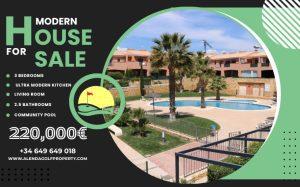
Situated amidst the tranquil mountains, this three-storey townhouse at Alenda Golf is a gem for investors eyeing the Airbnb or holiday letting market. Its strategic location, combined with top-tier amenities, ensures a consistent demand from visitors year-round.
The property boasts three luxurious bedrooms, including a master with an ensuite, a modern kitchen, and a spacious lounge that opens to a balcony overlooking the pool. The basement, elegantly decorated, leads to a garden with direct pool access.
Alenda Golf offers a range of amenities: an Olympic gym, a tapas bar with golf course views, a restaurant, and a supermarket.
Located just 10 minutes from Alicante and 15 minutes from its international airport, with four other golf courses within 30 minutes, it’s an ideal spot for golf enthusiasts.
Seize this opportunity to invest in a property that blends luxury with promising returns.
The Alenda Golf Course
Alenda Golf offers 18 holes of championship golf designed and built by Roland Favrat.
The golf course was completed in October 1999 and covers 49 hectares of land, 18 holes, par 72 and 6,257 metres in length, as well as an excellent 9 hole practice area.
The Golf School is guided by the Golf Federation of the Valencian Community.
Alenda Golf has been used as a European Tour Qualifying School and many Senior Spanish Championships have been held here.
A perfect and complete Golf Rental Opportunity, call Gloria on + 34 649 649
This website uses cookies to improve your experience while you navigate through the website. Out of these, the cookies that are categorized as necessary are stored on your browser as they are essential for the working of basic functionalities of the website. We also use third-party cookies that help us analyze and understand how you use this website. These cookies will be stored in your browser only with your consent. You also have the option to opt-out of these cookies. But opting out of some of these cookies may affect your browsing experience.
This website uses cookies to improve your experience while you navigate through the website. Out of these, the cookies that are categorized as necessary are stored on your browser as they are essential for the working of basic functionalities of the website. We also use third-party cookies that help us analyze and understand how you use this website. These cookies will be stored in your browser only with your consent. You also have the option to opt-out of these cookies. But opting out of some of these cookies may affect your browsing experience.
Necessary cookies are absolutely essential for the website to function properly. These cookies ensure basic functionalities and security features of the website, anonymously.
Cookie
Duration
Description
cookielawinfo-checbox-analytics
11 months
This cookie is set by GDPR Cookie Consent plugin. The cookie is used to store the user consent for the cookies in the category "Analytics".
cookielawinfo-checbox-functional
11 months
The cookie is set by GDPR cookie consent to record the user consent for the cookies in the category "Functional".
cookielawinfo-checbox-others
11 months
This cookie is set by GDPR Cookie Consent plugin. The cookie is used to store the user consent for the cookies in the category "Other.
cookielawinfo-checkbox-necessary
11 months
This cookie is set by GDPR Cookie Consent plugin. The cookies is used to store the user consent for the cookies in the category "Necessary".
cookielawinfo-checkbox-performance
11 months
This cookie is set by GDPR Cookie Consent plugin. The cookie is used to store the user consent for the cookies in the category "Performance".
viewed_cookie_policy
11 months
The cookie is set by the GDPR Cookie Consent plugin and is used to store whether or not user has consented to the use of cookies. It does not store any personal data.
Functional cookies help to perform certain functionalities like sharing the content of the website on social media platforms, collect feedbacks, and other third-party features.
Performance cookies are used to understand and analyze the key performance indexes of the website which helps in delivering a better user experience for the visitors.
Analytical cookies are used to understand how visitors interact with the website. These cookies help provide information on metrics the number of visitors, bounce rate, traffic source, etc.
Advertisement cookies are used to provide visitors with relevant ads and marketing campaigns. These cookies track visitors across websites and collect information to provide customized ads.